











We have published a few different articles on Grade Scales. Each article points out how difficult it is to really break down all the aspects of a different climbing objective. And indeed, things are made more complicated by comparative grade scales.
In this piece we’ll talk about difficulty in the realm of alpine climbing and how to assess how hard something might actually be.
American Commitment Grades
In this article we talked about the Yosemite Decimal System and commitment grades. As a reminder, here are the commitment grades as they were originally designed for big objectives:

The core issue with this system is that it simply doesn’t account for approach and descent. The system solely covers the actual route. This is incredibly problematic for alpine routes that require approach and descent time.
In the first edition of Select Climbs in the Cascades, Jim Nelson and Peter Potterfield introduced a novel concept. They used Roman numerals in their book for not-just-the-climbs, but for the approaches. In other words, a Grade I approach is going to be very quick, where as a Grade IV might take all day.
Unfortunately this alpine approach grade system never really caught on. And the most recent update of that book, Classic Cascade Climbs: Select Routes in Washington State no longer uses an approach grade, and instead provides a likely approach time. This can be problematic for those not used to complicated and brushy low-altitude route-finding in a range like the Cascades. It may take some time for climbers new to the area to make the times suggested in the book.
European Alpine Scale
The European Alpine Scale, sometimes referred to as the Global Overall Alpine Scale provides more nuance to alpine climbing objectives. In the Waddington Guide, by Don Serl, he notes that, “Alpine Grades in Europe sum up the challenge, difficulty and commitment of each climb in a consistent, comparable way. This can be best described as engagement, a measure of the stress and effort that a climber must accept to undertake a route.”
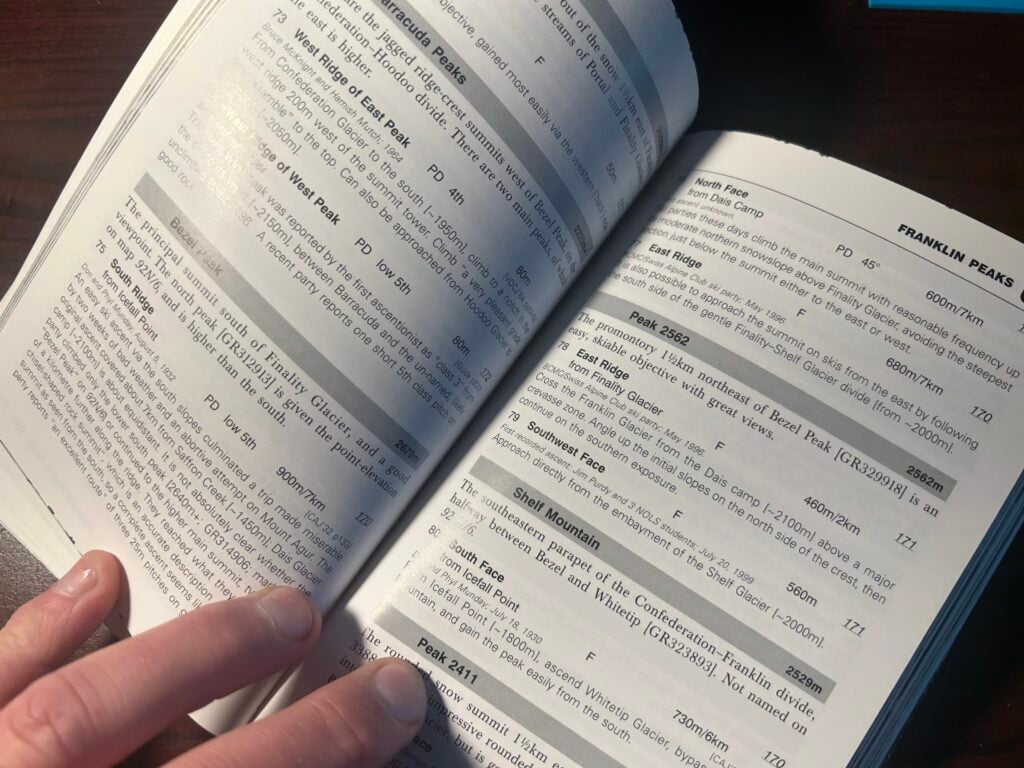
He goes on to write, “the primary factor affecting overall alpine grading is technical difficulty, but other important considerations are objective danger, how sustained and consistent the difficulties are, the quality of the climbing terrain, and availability of protection and belays. Physical effort, altitude, length, the difficulty of route-finding, the possibility of escape and/or retreat, the difficulty of approach and descent, and the remoteness of the climb, all contribute to lesser degrees. As Alpine Grades get higher, most of these factors also usually increase. Occasionally, when one or two factors (especially danger, length , and looseness) are exceptionally high, a climb will warrant a higher grade. Conversely, a climb which gets ‘high marks’ for only one of two factors and which presents little challenge in other aspects may be lowered a grade.”

It is not uncommon to see a plus symbol or a minus symbol with this system. Additionally, some will eliminate the EX and go from TD+ to ED1, ED2 and so on…
This grade system is often complimented by a technical grade. In North America, that would be in the Yosemite Decimal System, in the alpine or water ice system or in the mixed grade system.
As noted above, Serl used this system for the Waddington Range in British Columbia, which is clearly not Europe. You will see this system in many ranges throughout the world. You could even argue that it is the “go to” system in many places.
Alaska Grade System
Just to make things more complicated, it should be noted that Alaska has it’s own commitment grade system. These grades are rarely, if ever, applicable outside the Alaska Range. Following is a breakdown of the grade system from Joseph Puryear’s guidebook, Alaska Climbing.
- Grade I – An easy glacier route that can be climbed in a day from base camp. Altitude is generally not a concern.
- Grade 2 – A moderate glacier route with little to no technical difficulties that takes several days to complete. The West Buttress of Denali is a Grade 2 route.
- Grade 3 – A climb with moderate technical difficulties that takes several days. The climb may have extensive cornicing and knife edge ridges. The Sultana Ridge on Mt. Foraker is Grade 3.
- Grade 4 – A climb with more sustained moderate to hard technical difficulties and higher commitment. The climb will take several days to complete. The climb may have extensive cornicing and knife edge ridges. The West Ridge of Mt. Hunter and the West Rib of Denali are Grade 4s.
- Grade 5 – A climb with sustained hard climbing and a high level of commitment. Technical portions of the route may take several days. Bivy sites may be difficult to find. The climb may have extensive cornicing and knife-edge ridges. The Cassin Ridge on Denali is a Grade 5.
- Grade 6 – A climb with sustained hard technical climbing and the highest level of commitment. Technical portions of the route exceed 4000 feet and will take several days. Bivy sites are infrequent and hanging bivies may be required. The climb may have severe cornicing and knife-edge ridges and retreat options may be poor. The Infinite Spur on Mt. Foraker and the North Buttress of Hunter are Grade 6.
Like the preceding grade system, technical grades may also be included along with an Alaskan commitment grade.

We started where we finish. There’s no perfect system. But the more you understand about the systems that are there, the better you’ll be able to asses them for yourself.