

















“Jengis” – Slang for bogus, messed up, piece o’ crap, or, more formally, that which does not uphold the standards and conventions of established safety protocol.
“Jengis Anchors” – Not SRENE. Unsafe. For whatever reason the person making the anchor did not think that safety was important (or simply wasn’t thinking).
Okay. So I promise I’m not a jerk. But seriously, you’ve got to check these baaaad anchors out. These are real anchors that I found while climbing and guiding in the Ouray area this winter. They are proof that, despite the plethora of knowledge out there, some people should really take an instructional course about anchor building. What’s even scarier is that some of these anchors were built by group leaders that brought beginner climbers out for the day. Yikes!
I’ll go over each anchor’s problems and ways to fix it.
Case #1: Rappel Anchor
This is a rappel anchor I came across in the backcountry. There are two good cords tied around the tree. That part is fine. The bad part is next: There is one quicklink and one carabiner to rappel from. Really? Either two carabiners OR two quicklinks should be used. The way it is now, while there is some sort of redundancy, the two are not equalized. If the quicklink fails, the system will shock load the carabiner.
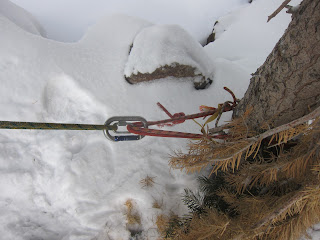
Case #2: Tree Anchor A

Case #3: Tree Anchor B
Again, the same setep. One piece of webbing girth hitched around the tree, with a single locker. If any part of this anchor fails, the anchor will fail. What to do instead? Instead of girth hitching the webbing loop around the tree, tie a proper SRENE knot, like a figure-8 on a bight.

Case #4: Tree Anchor C
Yep, same deal again. Yikes.

Case #5: Tree Anchor D

Okay, that’s all I can take for now. I’ll be posting more as I dig them up. In the meantime, keep building safe anchors out there. Be a part of the safe, educated climbers out there!
–Mike Pond, instructor and guide