
























Over the years people have slowly moved from rappelling off the harness to rappelling on an extension. Below are two videos that discuss the use of an extended rappel. First, we have a video from Climbing magazine’s former editor Julie Ellison.
And second, we have a short video from the American Alpine Institute:
Here are a few additional thoughts on the rappel extension.
Girth-Hitching the Sling
It is important that the sling is girth-hitched through the tie-in points on the harness. It should not be girth-hitched around the belay loop. This is because a girth-hitch crushes the loop and slowly wears it out.
Some choose to keep a PAS or a daisy chain attached to their belay-loop on a more or less permanent basis. This is very dangerous as it freezes the belay-loop in place, keeping it from rotating. The natural rotation of the gear-loop allows wear to disperse around the loop. When something is permanently girth-hitched to it, all the wear is focused into two places, wearing out the loop faster. To avoid this, we recommend girth-hitching through the tie-in point.
Redundancy
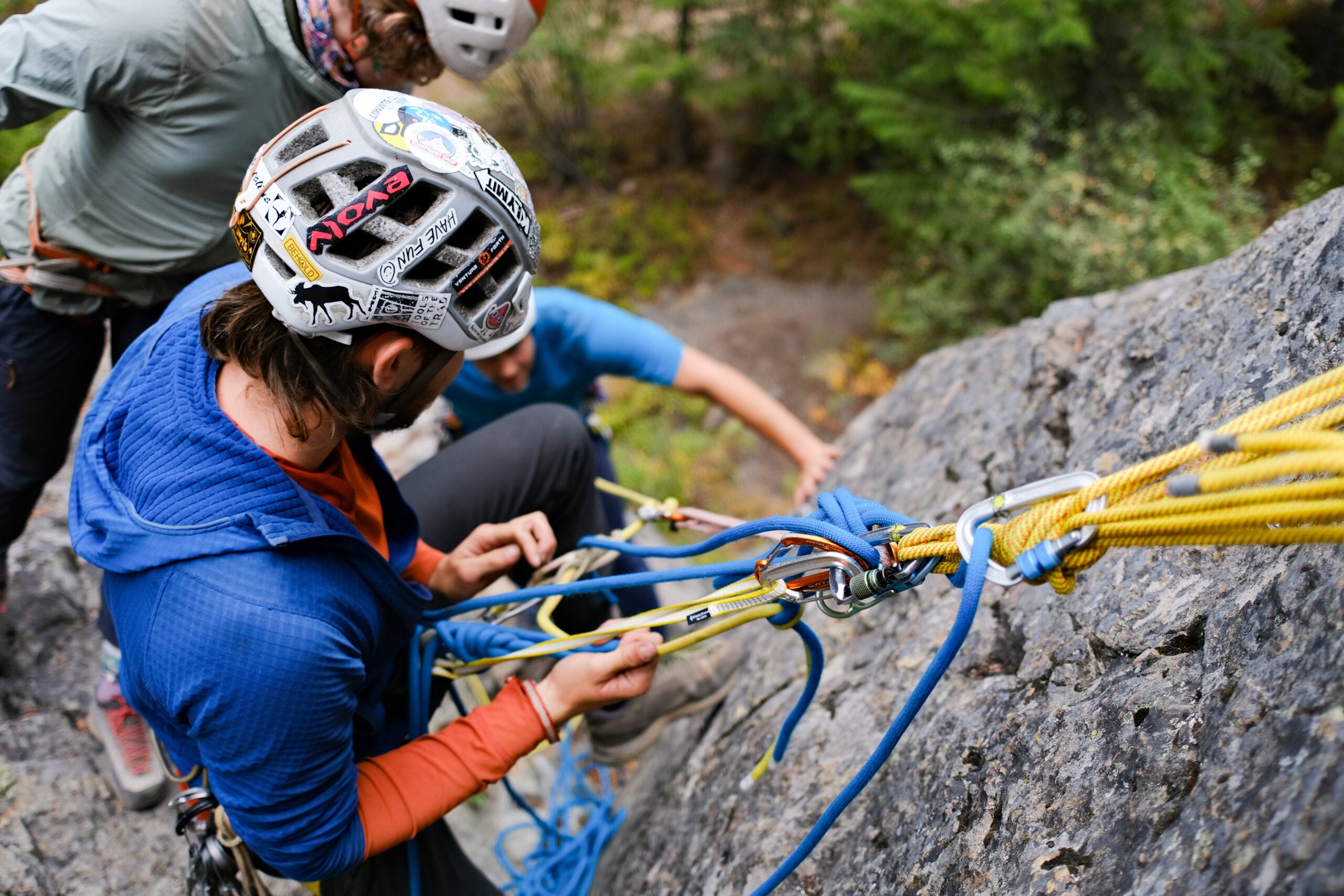
The Climbing magazine video shows the the clipping of the device inside the loop between the harness and the rope. To create additional redundancy in the system (at least while rappelling) it is possible to clip the device into both loops. That way, when you clip the end of the system back to yourself, you have a level of redundancy.
Type of Sling Used (Dynema)
If you use a Dynema sling there is a hazard. It is possible to generate a factor two fall when you clip into your anchor and then slip while above your anchor. In tests completed by DMM, Dynema slings did much more poorly than nylon slings. To see a video concerning this, click here.
Our recommendation is generally to use nylon slings in this application. But if you have to use Dynema, then you should be cognizant of this danger.
There are also a variety of personal anchor devices that work well in this setting.
Third Hand – Autoblock
Some people unintentionally clip the third hand to their leg-loop when they extend the rappel. There is no reason to do this. If your belay loop is clear, why wouldn’t you clip the autoblock to it? It’s the strongest part of your harness.
Third Hand – Letting Go
In the Climbing magazine video, there is an off the cuff comment about how your autoblock will save you if you let go. Indeed, that is the intent of the third hand. However, if the autoblock is loose or sloppy, it may not engage appropriately. As such, I generally still wrap the rope around my leg or tie a catastrophe knot below the autoblock in order to have some peace of mind when I have to go hands free.
Speed and Efficiency
One thing to consider is that the use of extended rappels in a multi-pitch setting allows more than one person to clip in at the same time. This can significantly expedite a descent and also allows you to check one another to ensure that everything has been set-up right.
I personally tend to extend my rappels at every opportunity. There are some places where it’s not terribly useful or realistic (like in a sport setting), but in trad and multi-pitch settings, it is definitely the way to go…down…
–Jason D. Martin