



































You’ve heard before, and I’ll say it again. The lower the angle between the pieces in an anchor, the better equalized the anchor will be.
What does this actually mean?
Well, first it means that the American Death Triangle is really bad…
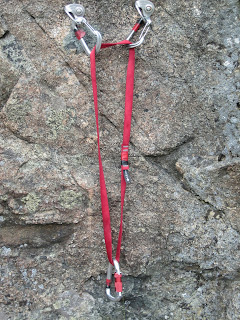
The American Death Triangle = Death
And second it means that…
If an anchor is composed of two pieces, and one piece is directly above the other piece, and you are using a pre-equalized knot on a cordellete clipped to the pieces, then you are likely to be close to completely equalized at your master-point. The photo below shows a three piece anchor with low angles between the pieces. The low angles make this a very good anchor. However, due to the fact that the pieces are not completely in line with one another, the anchor cannot be truly equalized.
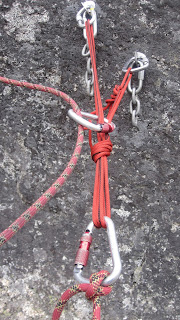
A Very Good Pre-Equalized Anchor on bolts that is Not Truly Equalized
Guides believe that this is an acceptable anchor.
Note: The rope running through the shelf is a means to decrease the
likelihood of a factor 2 fall on the anchor.
Some may find minor concerns with the different lengths of cord in the preceding picture. Most guides are not concerned about this.
When the angle on a two-point anchor increases, so too does the load on each piece. The theory is that when there is no or a very low angle — under 20 degrees — the pieces are close to equalized. When the angle increases to 40 degrees, then 54% of the load is on each piece. As the angle increases to 80 degrees, then 70% of the load is on each piece. And when the angle increases to 120 degrees, then 100% of the load is on each piece.
The following chart from the Technical Manual for Mountain Guides from the AMGA, demonstrates this with proposed weight of 1000 pounds.
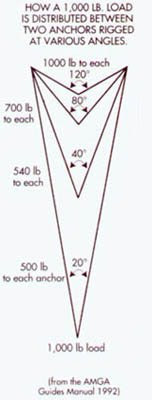
–Jason D. Martin
NOTE:
This is the second time we’ve posted this blog. And after I posted it the first time a couple of years ago an extremely valid comment was made. I thought that it would be prudent to post the comment as well as my response:
- I hate to flame people trying to put good information out for the public, but I thought his demonstration was pretty silly. First off(although it really wasn’t important for the demonstration) he had the knot of the cordelette directly on the carabiner of one of his “anchors”. You think that an IFMGA guide wouldn’t do this even in a demonstration. His demonstration really didn’t show the increase in force on the anchor, but the change in the direction of pull. I think he could of easily done this by attaching a simple fish scale to each anchor.

Jason Martin said…- I also thought about the knot on the carabiner when I found this video. The knot on the carabiner does weaken the cordellete mildly. But not really enough for it to matter.
In addition to this, lets remember what this blog is about. It’s about how angle impacts individual pieces…and I think that the video does a great job of demonstrating this…
Jason