

















There is a legitimate concern that some have put forward concerning this
blog. Occasionally, I get a little bit too techy and forget that
climbers with a multitude of skill levels read these articles. It’s good
to step back a little bit sometimes and make sure that everyone is on
board with some of the basics.
There are four terms that we use quite often on this blog. First, the
term top-rope. Second, the term lead, as in lead-climber. Third, the
term bouldering. And fourth, the term free-soloing. Following is a
breakdown of these terms and their definitions.
Top-Rope Climber
A top-rope climber is a person who has a rope running from his or her
harness, up to an anchor at the top of a cliff and then back down to a
belayer at the base. This is a standard technique, and it is the
technique regularly used for beginning level climbers and at rock gyms.
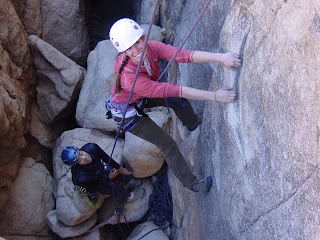
A Climber Belays another
Climber on Top-Rope in Joshua
Tree National Park
Photo by Jason Martin
The value of a top-rope is that it is highly unlikely that a
climber will fall very far. The rope can be somewhat tight if the
climber is a beginner or somewhat loose if he or she is comfortable.
Lead Climber
In essence, the lead climber is the guy that “gets the rope up there.” A
belayer pays out rope to a person as he climbs up. The leader places
rock protection as he goes and clips his rope to it. He then continues
climbing above the protection. Should the leader fall ten feet above
his last piece of protection, he will fall past his gear, and the
belayer will catch him after he has fallen twenty feet. The rope
stretches so that the impact is not as great on the leader.
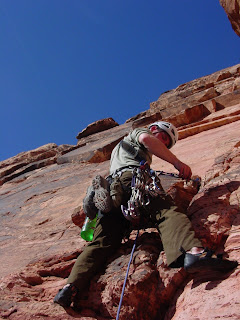
A Leader Working His Way Up a
Climb
The act of falling on lead can be very safe, or quite dangerous. It all
depends on whether the fall is “clean” or not. A clean fall means that
there is nothing for the leader to hit. A fall above a ledge or a
protrusion could lead to serious injury.
Leading can be done in a very responsible way that limits one’s exposure
to danger. But it does take a lot of training and practice to bring
one’s abilities to such a level where he or she has a good understanding
of what kind of gear placements will hold a fall and what kind will
not.
Bouldering
Bouldering is one of the fastest growing types of climbing. In this, a
climber does not use a rope, but also does not climb more than a few
feet off the ground. A boulderer is focused on making a handful of hard
moves and will often work on those moves for a long period of time
before completing a sequence.
Most boulderers use a pad or commercial bouldering mattress to protect
themselves from ground-falls. Every climber who falls bouldering hits a
mat or the ground, as such there is some danger involved in the sport.
Free Soloing
Often confused with free climbing, (which is simply climbing without the
use of direct aid, but with a rope) free soloing is the art of
climbing a route without a rope.
Obviously free soloing is the most dangerous type of climbing that there
is. If an individual falls in this situation, survival is highly
unlikely.
Climbing is a varied sport with many different aspects to it. Not every
aspect is for every person. Ultimately, the amount of risk that you
choose to engage in within the sport is completely up to you. Indeed,
the level of accomplishment you feel engaging in any kind of climbing is
also completely personal.
–Jason D. Martin