

















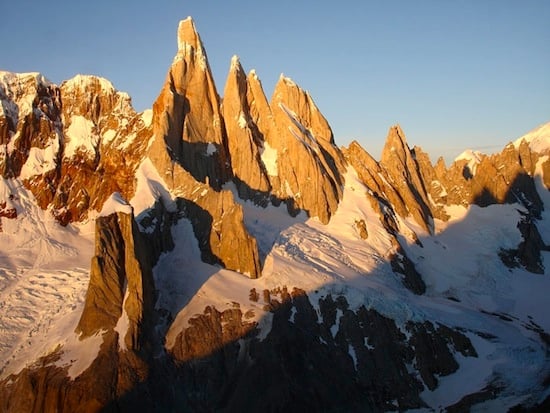



It is said again and again in rock climbing, “use your feet.” Unsuprisingly, it is also said over and over again in ice climbing. Good foot technique is the core to overall good climbing technique.
Ice climbers don’t have as many options as rock climbers. When an ice climber is on a frozen waterfall, there are only a few things that she can do to use her feet. She can frontpoint (the German technique), she can use the American technique or she can use the French technique.
Following is a simple breakdown of these techniques as they pertain to ice climbing.
Frontpointing
In mountaineering, we try to avoid frontpointing as much as possible. This is because it wears out the calves quickly. In waterfall ice climbing, it is incredibly difficult to avoid this technique. Indeed, most of the climbing that one will do on steep and vertical ice will require frontpointing.
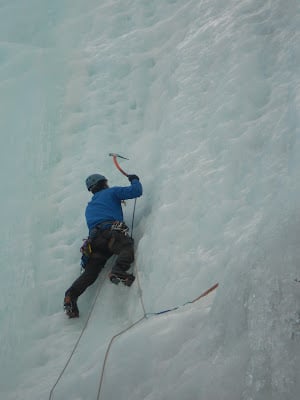
In this photo, the author’s feet are splayed out and he is frontpointing on steep ice.
Photo by Gene Pires
Proper frontpointing requires that not only the front two spikes are engaged, but that the second set of teeth are also engaged. To do this, a climber must drop her heels. This allows the secondary spikes to bite into the ice.
American Technique
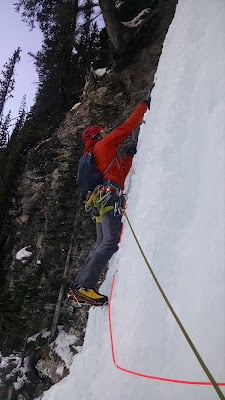
The American Technique is a great way to rest your calves while ice climbing. It is quite common for people to get fixated on frontpointing and not to take rests. The American technique allows for rests.
French Technique
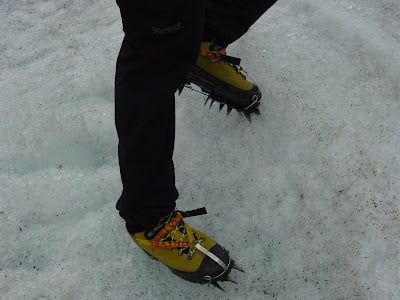
Fully engaged crampons do not work the legs anywhere near as hard as techniques that require frontpoints to be engaged. As stated above, French technique is a way to avoid overuse of your calves.
The simplest way to explain French Technique is that the feet stay flat. All points are in the ice. If you can do this on steepish terrain, then this will really allow you to rest. Indeed, areas where you can employ this technique are also some of the best for placing ice screws. Never ignore an opportunity to rest if it allows you to get gear, this can be scarce on ice climbs sometimes…
Some time ago, we did an entire article on French Technique and the use of the Cross-Over Step. To read that article, click here.
Whenever you ice climb, think about your feet. But don’t just think about them as cold lumps that might help you through the climb, but instead as a dynamic part of your body. If you always think of them as dynamic, it is far more likely that you will be able to use them in an effective way.
–Jason D. Martin