




























Fall factors are one of the most important ideas in climbing safety, and one of the most misunderstood. Many climbers file them away as a multi-pitch topic, something that only matters when a leader climbs above a hanging belay. In reality, fall factors matter in every form of roped climbing: single-pitch sport, trad, and even when you’re clipped into an anchor with a personal tether.
Once you understand them, they change how you think about where you place gear, how you manage the rope, where you build anchors, and how you attach yourself to them. Here’s what you need to know, with diagrams to make it concrete.
What is a fall factor?
A fall factor describes how severe a fall is relative to the amount of rope available to absorb its energy. You calculate it by dividing the distance you fall by the length of rope between you and your belayer:
Fall factor = fall distance ÷ rope out
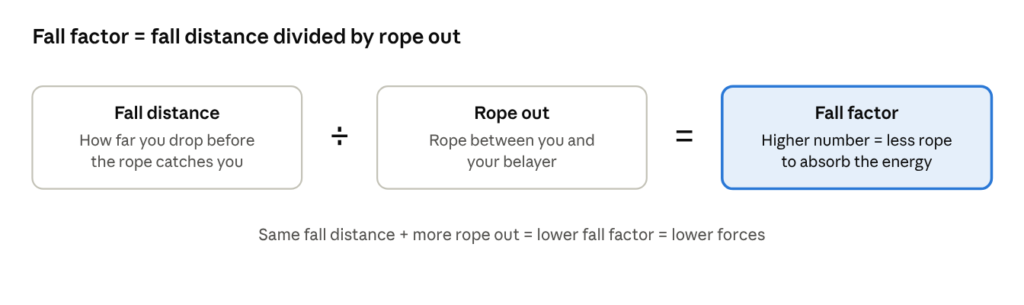
The higher the number, the harsher the catch. A dynamic climbing rope absorbs energy by stretching, and the more rope there is in the system, the more stretch is available. A high fall factor means a lot of energy and not much rope to soak it up.
Let’s look at three examples. To keep the math simple, they ignore rope stretch, slack in the system, and belayer movement.
Fall factor 1: close to the ground, but a serious fall
Imagine a climber with 6 meters of rope out and a protection piece 3 meters above the belayer. The climber is 3 meters above that piece, so if they fall, they drop 3 meters to the piece and another 3 meters below it before the rope comes tight: about 6 meters in total.
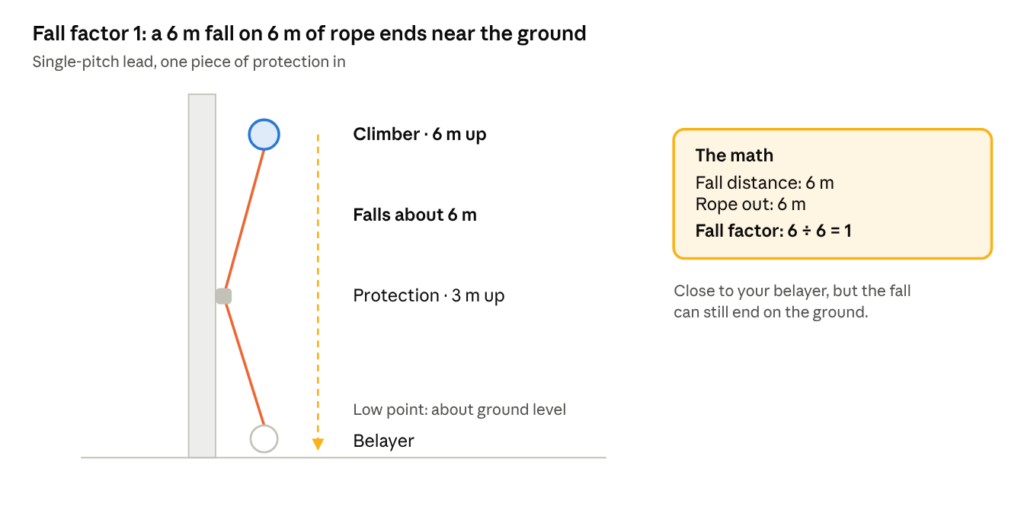
6 m fall ÷ 6 m of rope = fall factor 1.
That’s a relatively high fall factor. Even if the climber doesn’t hit anything, the forces can be substantial. And notice where the fall ends: roughly at ground level. Depending on the terrain and how much the rope stretches, this climber could hit the ground before the rope catches them.
This is why protection placement matters so much close to the ground. You can be quite near your belayer and still be set up for a serious fall.
Fall factor 0.5: the same fall, more rope
Now picture a climber with 12 meters of rope out and a protection piece 9 meters above the belayer. They’re 3 meters above the piece, so a fall is again about 6 meters.
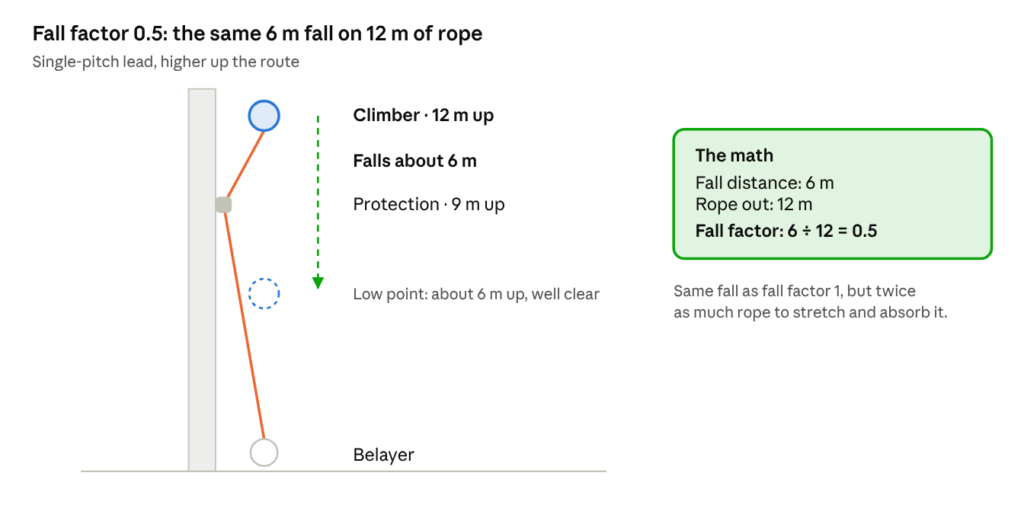
6 m fall ÷ 12 m of rope = fall factor 0.5.
The fall distance is identical to the previous example, but there’s twice as much rope to absorb the energy. That generally means lower forces on the climber, the protection, and the belayer.
This is one reason climbers place protection at regular intervals: good placements keep fall distances short while leaving plenty of rope in the system. The rope itself matters too. Dynamic climbing ropes stretch under load, absorbing energy and reducing the peak force transmitted through the whole system.
Fall factor 2: the worst-case scenario
A fall factor 2 happens when a climber falls twice the length of rope available to catch them. The classic setup is on a multi-pitch climb: the leader leaves a hanging belay and climbs above it without placing any protection.
Imagine that leader is 10 meters above the belay anchor, with 10 meters of rope out and no gear in. If they fall, they drop 10 meters back to the belay, then another 10 meters below it before the rope comes tight: about 20 meters in total.
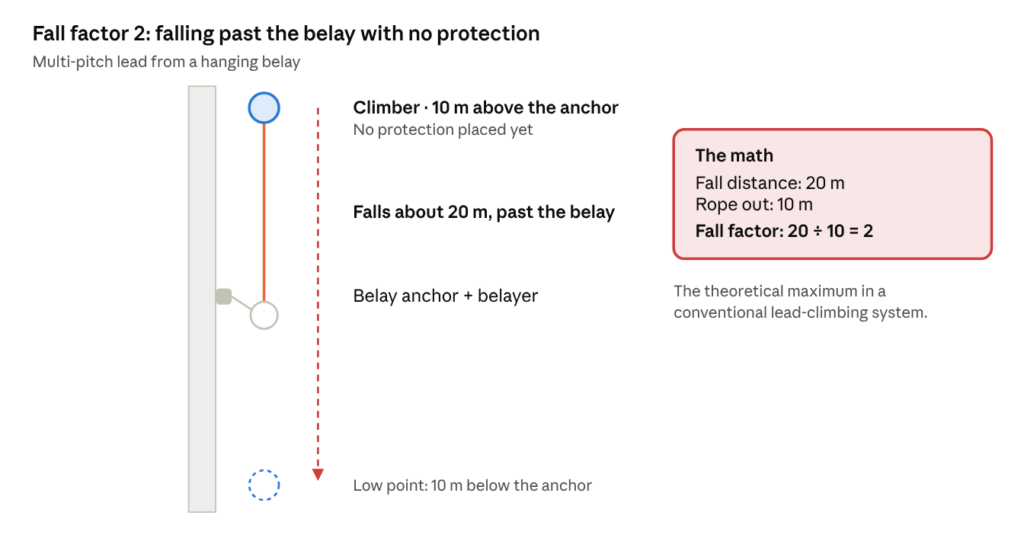
20 m fall ÷ 10 m of rope = fall factor 2.
This is the theoretical maximum fall factor in a conventional lead-climbing system. It can generate extremely high forces, because the rope has relatively little length over which to stretch, and the whole load comes straight onto the belayer and the anchor. It’s a scenario every climber should work to prevent.
On a single-pitch route with the belayer standing on the ground, the same situation simply ends in a ground fall, which is another reason the first few clips matter so much.
How to reduce the risk
- Place protection soon after leaving the belay. That first solid piece is what really brings the fall factor down, because it stops the leader from falling past the anchor.
- Consider clipping the anchor as your first piece. A fall then pulls the belayer up toward the anchor rather than yanking them straight down, which makes it easier to hold. It doesn’t lower the fall factor much on its own, so it’s not a substitute for getting gear in.
- Think it through at every belay. The terrain, the rope path, and the consequences of a fall all shape the right choice.
Fall factors and personal anchor systems
Fall factors aren’t just a lead-climbing concern. They also matter whenever you’re attached to an anchor with a personal anchor system (PAS), a sling, or another tether.
Picture a climber clipped directly into an anchor with a tether. While they hang below the anchor, the tether is tight and a slip goes almost nowhere. But if they climb or shift up above the anchor, a fall drops them past it until the tether comes tight below. That can mean a fall factor approaching 2, even over a very short distance.
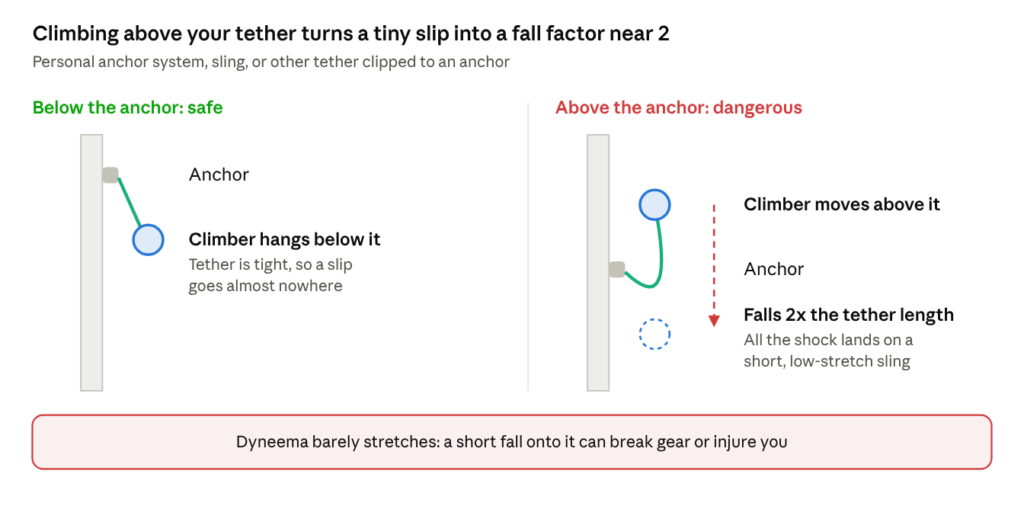
This is especially concerning with low-stretch materials like Dyneema slings. Unlike a dynamic rope, they absorb very little energy, so a short fall onto a static tether can generate enough force to break equipment or cause serious injury.
The lesson: a short fall is not necessarily a low-force fall. When there’s very little material available to absorb energy, even a small amount of slack can create dangerous loading. Keep your tether tight, and stay below your attachment point.
Why fall factors matter on single-pitch routes
Fall factors get most of their airtime in multi-pitch discussions, but they’re just as relevant at the crag. A few everyday situations where they come into play:
- Placing the first pieces. The distance between the belayer, your first protection, and you can create real fall potential close to the ground, where a fall factor near 1 can also mean a ground fall.
- Clipping into anchors. Moving above your attachment point at the top of a route sets you up for a high fall factor on a personal tether.
- Leading above any belay. Whenever you climb above the point your belay is anchored to without protection, the fall factor climbs fast.
- Managing the rope system. Any time you’re connected to protection, think about how much rope (or sling) is actually available to absorb a fall.
Recognizing these situations ahead of time is how hazards get managed before they become accidents.
Quick reference
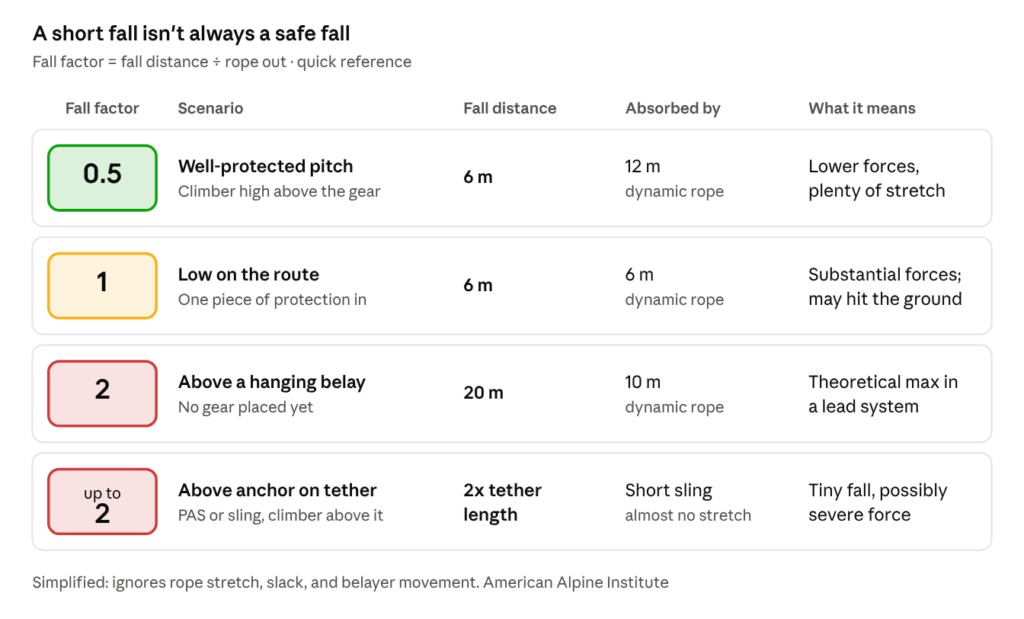
The takeaway: think about the entire system
Fall factors are a useful way to think about the relationship between fall distance and available rope, but they aren’t a complete measure of the forces in a real fall. Rope properties, belay technique, friction through the gear, the protection itself, and the system’s geometry all influence the actual load.
The most important thing to remember is that fall distance alone does not determine how severe a fall is. A short fall onto very little rope, or onto a static tether, can be far more dangerous than a longer fall with plenty of dynamic rope in the system.
Whether you’re on a single-pitch sport route, leading a long trad pitch, or transitioning at a multi-pitch anchor, keep fall factors in mind. Good protection placement, thoughtful anchor management, and appropriate personal attachment systems are fundamental to climbing safely.
Understanding the physics behind climbing systems is an important step toward becoming a more thoughtful, self-sufficient climber. At the American Alpine Institute, we emphasize the connection between technical skills, sound judgment, and practical risk management at every level of climbing education.