



























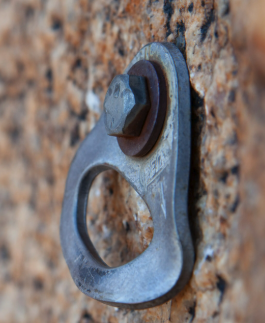
Picture it: you’re twenty feet up, the next bolt is just ahead, and the hanger looks like someone took a hammer to it. It’s bent, warped, or flattened against the rock. Is it still good?
The short answer is that you should treat it as unsafe.
Modern certified hangers are tough, often rated between 22 and 35 kN. But those ratings apply to hangers in their original, undamaged shape. Once a hanger is physically deformed, that number no longer tells you much.
Why a Bent Hanger Is Weaker Than It Looks
Hidden damage inside the metal. Bending metal concentrates stress in the bent area. If the hanger was deformed by a big fall, rockfall, or an installer hammering it to fit uneven rock, tiny micro-fractures may have formed. You can’t see them, but they can substantially lower the hanger’s minimum breaking strength.
Leverage where there shouldn’t be any. A hanger is designed to sit flush against the rock so a fall loads the bolt in shear, straight down along the rock face. A warped hanger can lift away from the wall or change how the carabiner sits. That creates a lever arm, multiplying the force on the bolt shaft and cutting the system’s real-world capacity.
Damage to your gear. Deformed hangers often have burrs, nicks, or sharp edges. Clip a carabiner into one and those edges can scar it, and a scarred carabiner can fray or cut your rope.
What to Do When You Find One
1. Back it up. Don’t trust a badly bent hanger as your only protection. If you have to clip it, look right away for a secondary placement, like a nearby trad piece or another reliable bolt, so you aren’t relying on it alone.
2. Reduce the leverage. If the hanger is bent because the bolt was poorly installed and sticks out from the rock, you may be able to girth-hitch a wired stopper or narrow sling around the bolt shaft, tight against the rock. This keeps the load close to the wall and reduces leverage. Treat this as a stopgap that depends on your judgment, not a fix.
3. Report it. Take a photo and note the route name and pitch. Then report it to your local anchor replacement fund, climbing coalition, or a database like Badbolts.com. Reporting is how bent hardware gets replaced with new stainless steel, and it protects the next climber.
The Bottom Line
When a piece of fixed gear looks wrong, trust that instinct. A bent hanger might hold, but you can’t know that from the ground or the rope. Back it up, avoid loading it directly, and let the people who maintain your local crag know about it.