











This last winter, AAI Guide Alasdair Turner spent the winter working and living in Antarctica. This week our blog will feature a special three-part series on Alasdair’s experiences…
Click on any of the photos to enlarge them.
__________________________________________________
Science
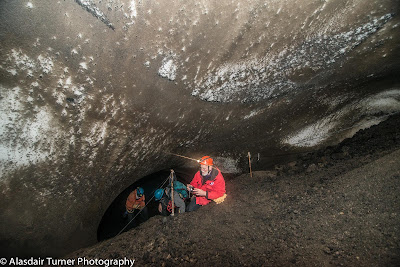
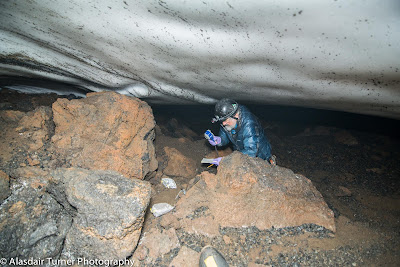
Thermal imaging is used to find the hottest areas of soil.
WISSARD Project:
Wissard is a project that is drilling 800 meters through the Antarctic ice to investigate and sample water and sediments underneath.
http://www.wissard.org
Long Duration Balloon:
http://www.nasa.gov/centers/wallops/news/antarctic2012.html
B-009 – Weddell Seal Science
http://weddellsealscience.com
Exploring the bottom of Antarctica food chain
http://earthref.org/ERESE/projects/GOLF439/2012/
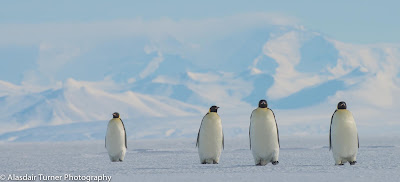
Penguin Research:
http://www.penguinscience.com/
Weather
Antarctica is cold, but you probably already knew that. What surprised me was just how cold it can be. After doing seven climbing trips to the Denali area I did not think the cold would be that much of an issue. It is. It can be an issue for everyone and everything we do. It is so much colder than anywhere else I have ever been that I was a little surprised by it. I arrived in McMurdo on October 1st. October is a pretty cold month, but it starts to warm up quite fast as the 24-hour day light gets closer. December can actually be quite warm and I found myself walking around McMurdo in a t-shirt on numerous occasions. Keep in mind by warm I mean close to freezing. Due to the dry air and the solar radiation a temperature close to 0 degrees C can feel quite warm if the wind is not blowing.
There is a daily weather forecast at McMurdo which is about as accurate as one might think(not really).
Unlike the US, Antarctica does not have that many weather monitoring stations so figuring out what is happening with weather a day or two out can be difficult. If stationed at a field camp it is possible to call into McMurdo to get the forecast for your camp but the inevitable answer from the weather folks comes in the form of the question “well, what is it like there now?”
There are three categories of weather in and around McMurdo:
Condition 1Windspeed over 55 knots (60 miles per hour)Visibility less than 100 feet (30 meters)Wind chill below −100 °F (−73 °C)Description: Dangerous conditions; outside travel is not permitted.
Condition 2Windspeed of 48 to 55 knots (55 to 63 miles per hour)Visibility 1/4 of a mile to 100 feet (402 to 30 meters)Wind chill of −75 °F (−60 °C) to −100 °F (−73 °C)Description: Unpleasant conditions; outside travel is permitted but not recommended.
Condition 3Windspeed below 48 knots (55 miles per hour)Visibility greater than 1/4 of a mile (402 meters)Wind chill above −75 °F (−60 °C)Description: Pleasant conditions; all outside travel is permitted.
At no time in my five months on station did I experience a condition 1 at McMurdo. I did experience weather that would fit into that category while on Mt. Erebus however.
Antarctica is dry. Very dry. Most people think because there is a lot of snow and ice that it must snow a lot. It does not. Most of antarctica is considered a desert. Most of the snow McMurdo Station gets is from ocean moisture. The air is very dry and sleeping with a humidifier in dorm rooms is very common.
Antarctica is pretty windy. It is notorious for its winds, however winds in McMurdo are often not too bad. McMurdo does not get the catabatic winds that many other places do. Winds are fairly common out on the ice shelf where we teach our happy camper courses. Wind makes it feel colder, and makes it more likely you will get frostbite.
I was lucky enough to be out at the Scott Base pressure ridges when a storm was rolling in. Major storms usually come from the south.

Fata Morgana stretches the base of the Royal Society Mountains.
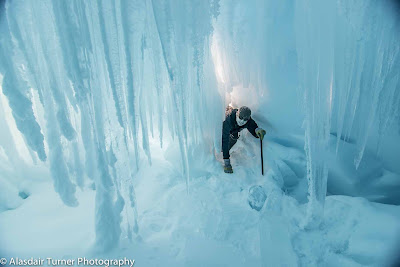
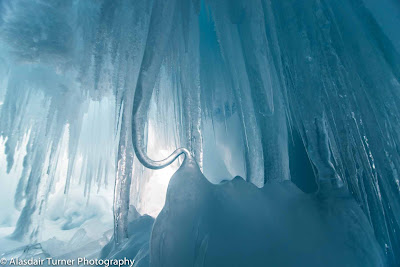
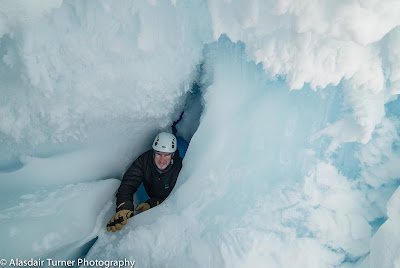
Ice Cave
The Erebus glacier tongue is the end of the Erebus glacier that comes off Mt. Erebus. The glacier tongue floats on the ocean and extends a couple of kilometers from land. Due to the constant glacial movement of the tongue pushing out to sea, the sea ice around it contains several cracks that are often challenging to deal with. This makes it a perfect place to teach the field sections of sea ice courses. It was during one of these courses that we noticed a small hole in the wall of the glacier. The next day while conducting some sea ice monitoring we dug out the hole to find an incredible cave. This cave and others like it, are formed when crevasses in the glacier become covered by snow bridges. The surface melt water then percolates through the roof creating icicles. These caves are often used as a recreational outing for the people in McMurdo Station, but this year a lack of suitable vehicles to transport people, in addition to other things meant that very few people would be allowed to see this amazing natural wonder.