

























To daisy or not to daisy, that is the
question:
Whether ’tis nobler
in the mountains to suffer
The lightning and the wind tied in with a
clove
Or to take arms against a sea of anchors
With a Daisy or a
PAS…Alas a broken daisy,
To die, to sleep — the undiscovered
mountain —
From which no climber has ever returned…
Okay,
I admit it, I’m not Shakespeare and even the most serious of free
soloists is nowhere near as depressed as the Prince of Denmark. But I
have spent a fair bit of time thinking about both Hamlet and daisy
chains. I know some of you are wondering how they are connected.
They’re not…except in my very bad Shakespearean verse.
Daisy
chains are a very tricky tool. When used correctly than can be
tremendously valuable to a climber. When used incorrectly, they can be
incredibly dangerous.
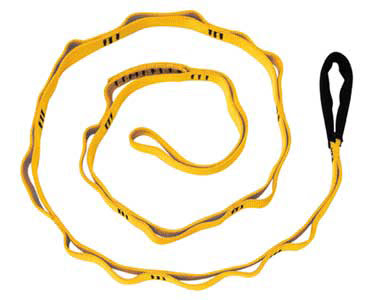
The
main advantage to the use of a daisy chain is that most people leave
them permanently affixed to their harnesses. As such, when they get to
an anchor they can quickly and easily clip in. The use of daisy chains
is especially valuable when one is trying to set-up a top-rope and needs
to clip into something near the lip to remain safe or when one needs a
safety attachment for a series of rappels.
It is possible for a
daisy chain to fail. If you clip the end of the chain and then clip a
loop, the internal loops can come apart as well, causing a catastrophic
failure. There are two ways to avoid this. First, you can put a twist
in the end of the daisy so that it cannot fail. Or second, it is
possible to use two carabiners.
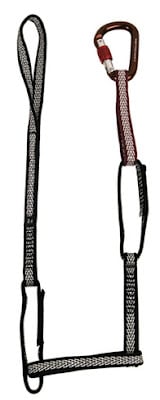
The preferred attachment to
the harness should be via the tie-in point. A girth-hitch through the
tie-in will do significantly less damage to the harness and will
ultimately be safer.
Most guides do
not use daisy chains or the PAS. Instead, they will use their
rope to tie directly into the anchor with a clove-hitch. The advantage
to a clove-hitch is that it is adjustable once you are off belay. There
are styles of daisy chains which allow this, but the amount of
adjustment provided is minimal. With a rope, one has the ability to
make major adjustments. For example, it’s nice to tie into the anchor
with a clove, then give yourself enough slack to go back over to the
edge of the cliff, so that you can hear and be heard.
Guides
often use slings in lieu of a daisy chain. The is because there is
little need of a daisy in most multi-pitch environments.
Daisy
chains are most useful in either a single pitch or an aid climbing
environment. If you’re climbing primarily in these environments, then
you should definitely consider using a daisy. If you only occasionally
play in these types of environments, then a couple of slings are much
lighter and can be used in more applications.
–Jason D. Martin