














Former AAI Program Coordinator and Guide
If you have made it as far as researching guided climbs of Denali (formerly known as Mt. McKinley) on the web, chances are you have a fair amount of mountaineering experience under your belt. Many climbers who decide on climbing denali with a guided expedition don’t “need” a guide service to lead them to the top of the mountain, but choose a guided trip for secondary reasons.
Here at American Alpine Institute, we approach our role as a guide service as facilitators, organizers, managers of safety, and as the head of the decision making process. AAI’s founding mission is to help climbers become independent and self-sufficient; we hold strong to that ethic and respect the unique abilities, knowledge, and perspective that each expedition member brings to the table.
Consideration #1: Guided or Unguided?
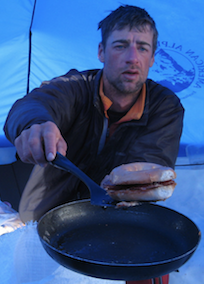
The author preparing a breakfast sandwich at Camp 3, Denali West Buttress
As mentioned above, many – if not most – climbers joining a Denali trip are more than capable of carrying out the logistical details for and conducting a safe climb on Denali’s West Buttress. However, a guided trip offers climbers the opportunity to not have to worry about food, fuel, group gear, and larger areas of risk management.
Climbers planning to ascend the mountain on their own face the daunting tasks of researching the route , preparing weeks worth of food, arranging for their glacier flight and other logistical details, and planning day to day itineraries, not to mention undertaking a two to three week ascent of a complex route on a very high, cold, and unforgiving peak. Most of the expenses that are included in the cost of the typical guided Denali climb – such as glacier flights, food, fuel, and shuttle fees – are also present for climbers planning their own trip. On average, most climbers spend $2,500 on gear, food, glacier flights, and miscellaneous expedition expenses (minus airfare to Alaska) for a three-week trip on the West Buttress. One of the first decisions most Denali climbers face is whether or not to trade the huge task or organizing their own expedition for the support and leadership of an experienced guide service.
By joining a guided trip, climbers can forget about planning the above logistics. Considering that most guided trips run in the neighborhood of $7,000 – $8,000, many climbers opt to forego the months of planning in favor of paying a bit more and having to worry only about taking care of themselves.
There are also advantages to undertaking the expedition without a guide service. For one, you get to set your own pace and adjust your itinerary as you care to. Additionally, you are typically very familiar with the other climbers in your group as well as the extent of their abilities and training. And the cheaper cost cannot be overlooked!
Consideration #2: Choosing a Guide Service
If you do end up deciding that you would like to join a guided trip on Denali you should be aware that not all guide services are created equal. Choosing a guide service can be a difficult and complicated thing. Below are some guidelines for researching and evaluating guide services on Denali.
Factor #1: Are they legitimate? Unfortunately, false and/or deceptive advertising is not an uncommon thing in the guiding industry, especially given that the web is such an accessible and easily modified tool.
There are currently only seven guide services that may legally guide climbing trips on Denali /Mt. McKinley. Only authorized concessioners, of which American Alpine Institute is one, may display the NPS logo on their website. The Park publishes a list of the authorized guide services on their web site, in addition to many other interesting facts on the park and particularly on climbing Denali.
Note that there are many unauthorized guide services that claim to offer guided trips on Denali. There are two explanations for this: either they are guiding illegally without a permit; or they are offering their trip through one of the authorized guide services (this is technically not permitted by the Park regulations). Keep in mind that the internet is the great equalizer in advertising and promotion these days. Not all offerings are as one might think or as they may appear. Be very cautious if exploring trips that are advertised by services other than the authorized concessionaires and make sure first and foremost that the trip is actually run by a permitte, and then asses the viability, organization and other details of the advertised trip.
Factor #2: Approach, Strategy and Quality of the Trip. Succeeding on Denali only happens when complete planning, adequate training, good decision-making, and a little luck all align. On a complex and intense expedition like this, knowing a few tips, tricks, and more importantly following a tried and true strategy that has been developed after years of experience can greatly stack the odds in your favor.
Most companies publish their success rates for both individuals and expeditions on Denali. While not a perfect indicator of the quality of the trip, success rates are a good thing to consider and at least be aware of when looking at guide services. Success on Denali should be defined as returning safe and with all extremities intact. The summit is a bonus and a reward for careful planning and preparation, good decision-making, and a healthy dose of luck. If a guide service is following these policies in the pre-, during, and post-trip phases, they will likely have a good (better than average) success rate. If a company has a very good success rate, this is more than likely an indicator of a company and employees that are far above average. However, more than one company in the guiding world can tout an excellent success rate but without the satisfaction of providing quality experiences for climbers. Some climbers only want to stand on top and are willing to sacrifice the quality or enjoyment of their experience to be able to say that they have reached or achieved that goal.
The best thing we can tell you to do here is to make a lot of phone calls, write a lot of emails, and try to get a feel for each company, their programs, and their approach to climbing and guiding. Ask to speak with one of the company’s actual Denali guides. Most major guide services on Denali have very similar trips with regard to inclusions/ exclusions, cost, length, climber-to-guide ratio, and general trip logistics. There are a few differences, but none that should be the driving force behind your decision. The real differences are in company philosophy and quality of the staff.
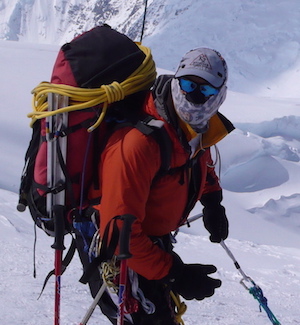
An AAI guide dressed for wind and sun, Denali West Buttress
Factor #3: Staff. A company’s staff is an extension of that company’s philosophies, policies, approaches, and mentalities. A staff member can only be as good as the company allows them and helps them to be through training and support. Likewise, a company can only be as good as the people representing it in all facets of its operation. Most guide services publish information on their instructors and support staff and include a brief overview of their credentials. Information like this can give you excellent insight into the nature of the company and the quality of the individuals representing it.
Factor #4: Cost, inclusions, and exclusions. The “bottom line” dictates much in today’s day and age. Though there is some truth in the age-old adage “you get what you pay for,” a higher cost doesn’t necessarily mean a better trip and a lower cost doesn’t always mean a lesser trip. Good companies have bad trips and vice versa. Always bear in mind that few things run perfectly to plan in the mountains. The Park rangers say it best when they say that to succeed on Denali, “you need to maintain a rigid state of flexibility.” When shopping around for things like cost, inclusions and the like, make sure you are comparing apples to apples and ask about other costs you might expect to incur in addition to the expedition fees. Some companies will leave out certain things that others might consider standard in order to affect a lower price. Likewise, another company might appear to have a much higher rate, but in turn offer more goods and services in return for the fee.
Factor #5: Safety. Ask about the guide service’s track record with regard to safety and accidents both on Denali and in the other areas of their operation. Ask the Park and ask the guide service. Search the internet for news reports.
Factor #6: Equipment. You can’t climb the mountain without the right tools for the job. Careful selection of group gear such as ropes, tents, stoves, and expedition equipment is essential to an expedition’s success and safety. Another huge part of the equipment process is the level of support that a guide service is able to provide when it comes to helping you select your gear for the expedition. Many guide services select and employ new and updated gear every year for Denali climbs while other services choose to use old gear until it fades away or disintegrates from use. Ensuring that the gear you will be using on the mountain is the finest available can make or break your expedition.
Click here to learn more about AAI’s Denali Climb.